

When I say “simplify the living room,” I don’t mean strip it down to nothing. I mean, let’s get aligned!
Before I moved a single chair during our snow days with the whole family, I asked myself three questions:
- How are we actually using the space this week?
- What is getting in the way of that?
- What needs to be temporarily removed, relocated, or repurposed?
That’s it—that’s the process!
During our recent stretch of cold weather, I knew our blended family would be indoors, moving between games, food, conversation, and quiet moments. So, I simplified the room with that reality in mind. Here’s what that looked like:
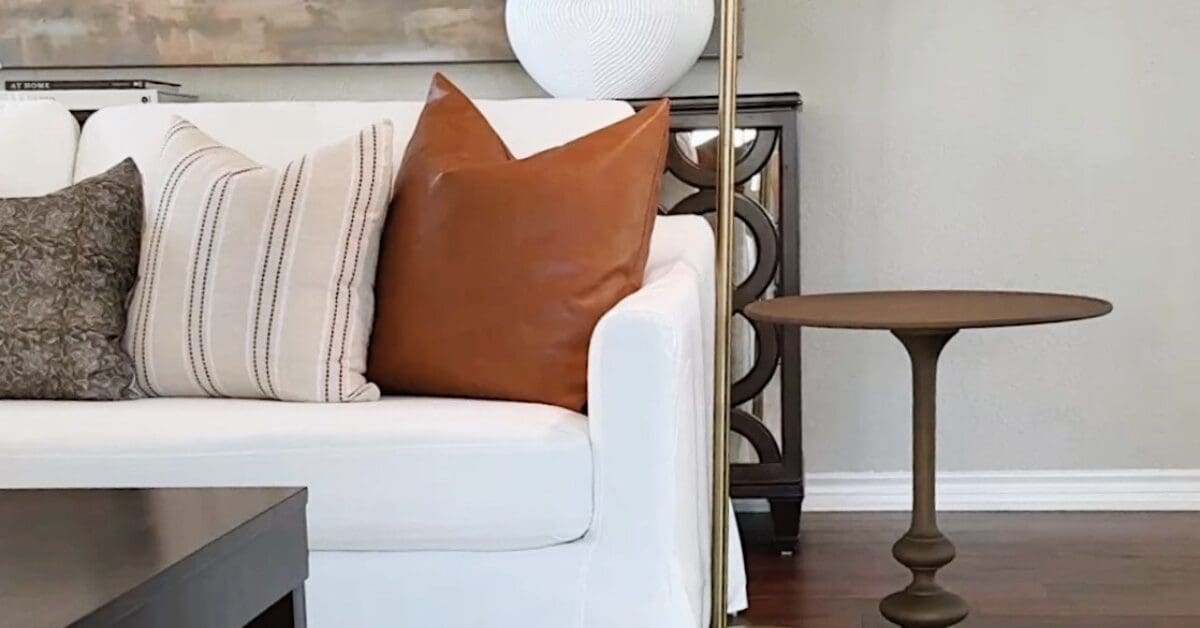
I removed decorative pieces from surfaces that needed to become functional. I cleared excess throw pillows so seating could flex easily. I relocated items that belonged in other rooms—mail, bags, overflow, clutter. I widened walkways by adjusting furniture placement. I cleared one surface entirely so it could become a game table.
Simplifying is not about getting rid of everything; it’s about creating margin for how you live right now. If your family gathers differently, your simplification process will look different, but the questions remain the same: Does it support how we live? Is this in the way? Is this adding value or adding noise? When you simplify with intention, you create capacity—not emptiness.
Simplifying Examples for Different Brain Types:
If you are the “visual clutter” person, you can’t relax if you can see it. Keep only your top three visible decor pieces per surface. Put the rest in a basket or cabinet and rotate seasonally. Choose one “drop zone” container and remove the rest. Your simplified win: fewer visible categories.
If you’re the “out of sight, out of mind” type, you want it hidden but still accessible. Use closed storage! For example: ottomans, baskets with lids, and cabinets. Create one-step put-away homes rather than five-step ones. Keep essentials within arm’s reach. Your simplified win: hidden but easily accessible.
If you’re the “sentimental keeper”, simplifying feels emotional, not practical. Create a memory spotlight area. One shelf, one surface. Store the rest safely with intention. Ask yourself: Does this belong in the gathering space or in a keepsake space? Your simplified win: honor the memory without crowding the room.
If you are the “busy parent” or “blended family operator”, you’re just like me—you need systems that survive real life. Simplify anything that requires constant maintenance. Reduce duplicates—extra blankets, random toys, too many games out. Create flexible reset bins for quick pickup. Your simplified win: the room resets fast.
If you’re a minimalist, you might already have less, but it can still feel off. Simplify the layout, not just the stuff! Remove anything that blocks movement or the flow of conversation. Ask yourself: Is this room missing warmth or comfort? Your simplified win: function and ease, not emptiness.
To simplify the living room isn’t about achieving some magazine version of “done.” It’s about paying attention. Life changes week to week—snow days, sick days, game nights, hard conversations, ordinary Tuesdays—and your space can shift with it. The goal isn’t less for the sake of less. It’s ease. It’s movement. So when life shifts again (because it always does), come back to the three questions. Adjust. Make room. Let the space serve the people inside it. That’s the work. That’s alignment.


Leave a Reply